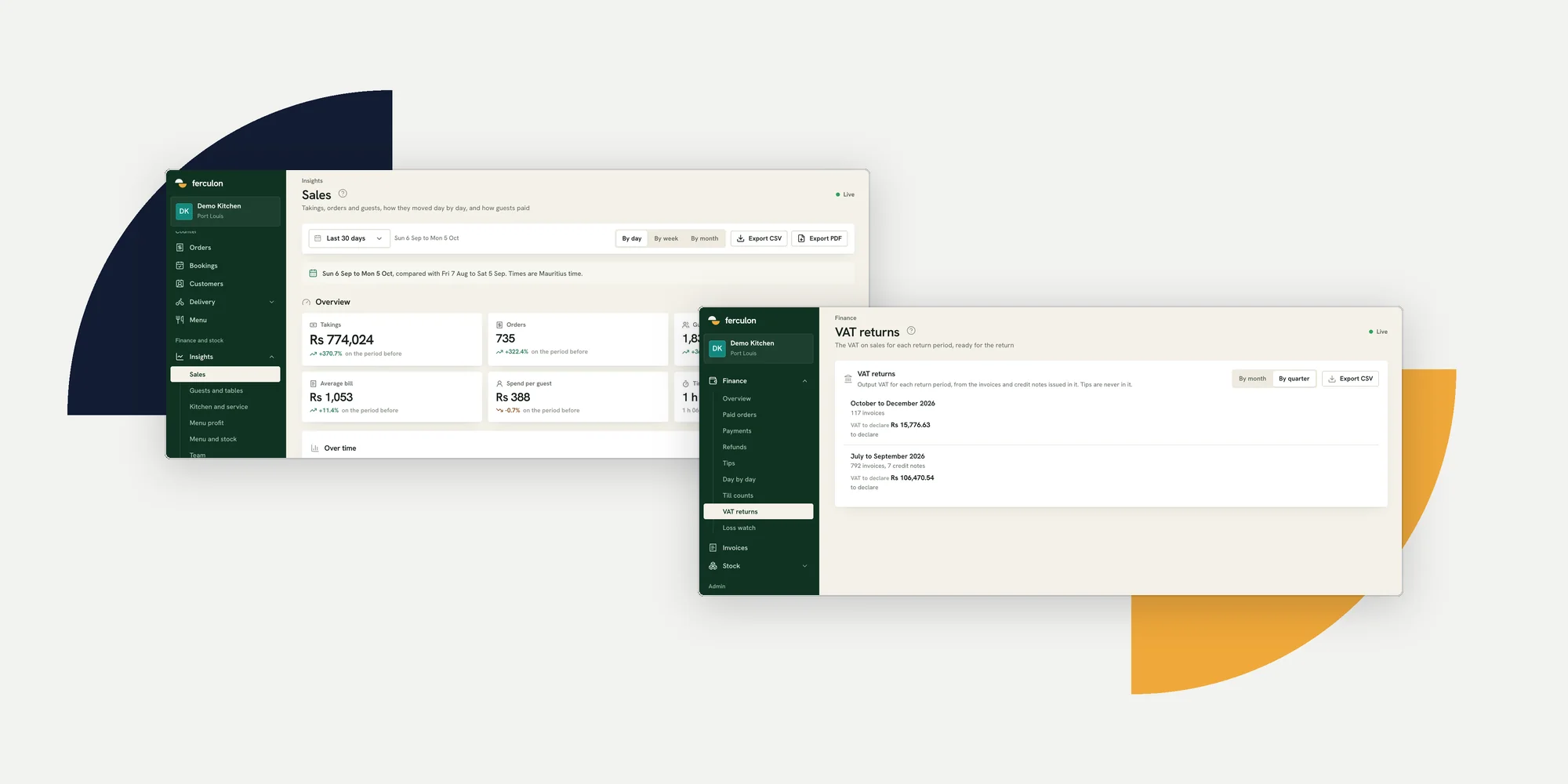
A restaurant management system in Mauritius runs the whole restaurant, not just the till: the floor and the orders, the kitchen, the guests who book or order online, the stock behind the dishes, the staff who are clocked in, and the figures the accountant files from. A point of sale is one part of it. We build one for this market, so we can be precise about which parts earn their cost here and which are sold as features and never used.
This guide sets out what the whole system has to cover here, in the order it matters, and shows the screens where each part lands in Ferculon. Every figure in the screenshots comes from a working restaurant set-up, and every rule quoted is current.
A point of sale against a management system
The two are sold as if they were the same product. They are not, and the difference is visible on the second Monday of the month, when somebody has to explain where the margin went.
| The question | A point of sale answers | A management system answers |
|---|---|---|
| What did we take? | The total for the day | The total by payment method, by order type and by the person who took it |
| What did we sell? | Which dishes left the kitchen | What each dish made after its recipe cost, against the others in its own section |
| What do we owe? | The VAT on one receipt | The VAT on sales totalled for the return period, with credit notes in it |
| What is in the store? | Nothing | What should be there from the recipes, against what the count says is there |
| Who did that? | Nothing | Every void, discount, refund and drawer opening with who approved it |
| What happens tomorrow? | Nothing | What the same weekday sold, what to prep and what runs out before the delivery |
| What did we throw away? | Nothing | Waste booked by item against the stock counts and the deliveries |
| What should I look at today? | Nothing | A brief of the day so far against the same day last week, and a seven-day forecast |
None of the right-hand column is exotic. It is the ordinary work of running a restaurant. The reason it ends up in a spreadsheet is that the till was never built to do it, and the spreadsheet is where the margin quietly goes.
Who is actually at the table in Mauritius
The guest mix decides more about the system than the feature list does. Statistics Mauritius, in International Travel and Tourism for the first quarter of 2026, records 348,445 tourist arrivals in the quarter against 326,389 a year earlier, a rise of 6.8 per cent. Seven markets accounted for 66.5 per cent of them, the largest being France with 83,557, then Reunion Island with 34,381, Germany with 35,007 after a rise of 50.3 per cent, and the United Kingdom with 29,162.
Three consequences for the system you buy. Your biggest single market is French-speaking, so a guest-facing page in English only is working against it. Arrivals swing hard by month, so the back office has to compare a Tuesday in February with a Tuesday in July rather than with last week. And a large share of covers are people who will never come back, which puts the weight on getting the service right the first time rather than on loyalty schemes.
The money side: VAT, wallets and the cash-up
This is the part that is local, and the part generic software gets wrong. Compulsory VAT registration now applies once annual turnover of taxable supplies exceeds, or is likely to exceed, Rs 3 million, down from Rs 6 million with effect from 1 October 2025, at a standard rate of 15 per cent. A great many restaurants crossed that line without changing anything about how they record a sale.
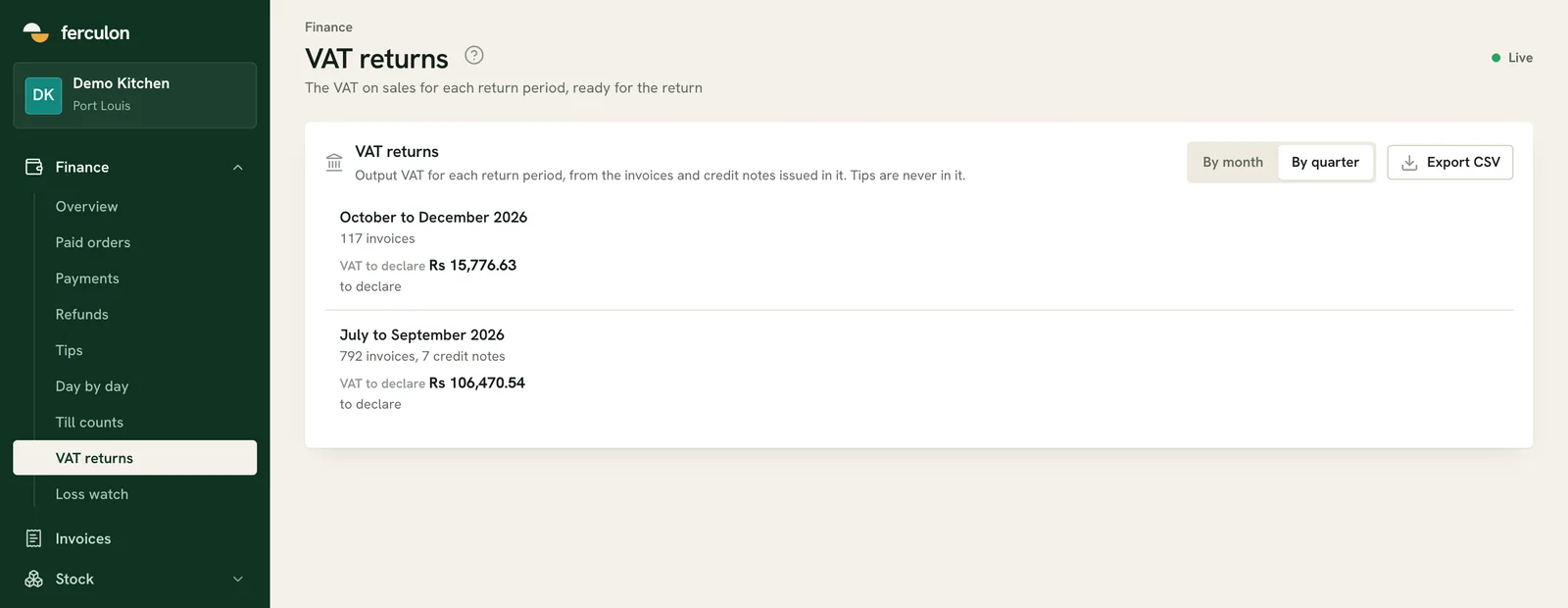
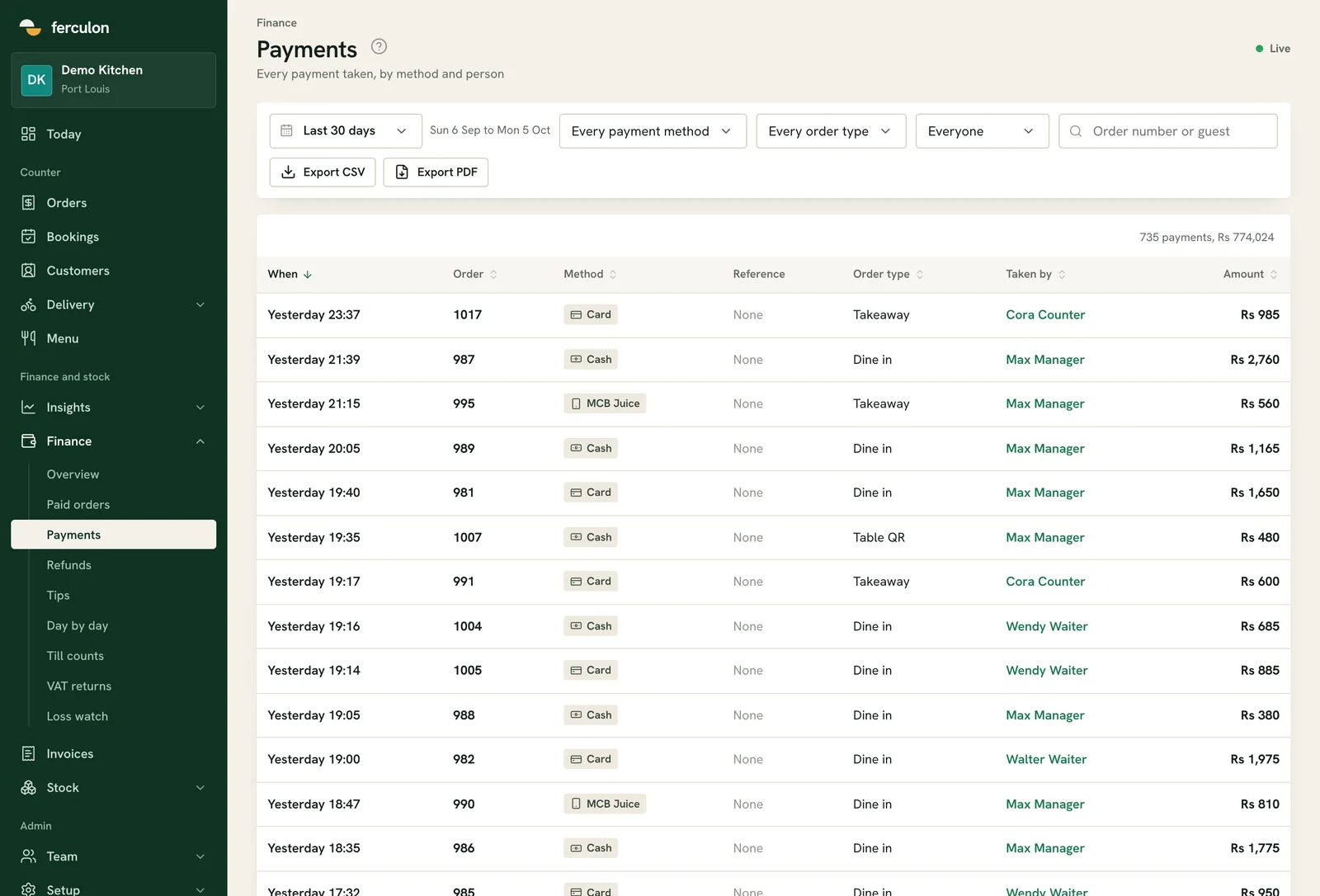
The other half is how guests pay. Cash and card are not the whole picture here, and a wallet transfer that is recorded without its reference will not reconcile at the end of the night. The system has to hold the payment methods your restaurant actually takes, record the reference your staff type in, and then give you the day split by method and by person.
The kitchen is where a service is won or lost
A management system that stops at the counter leaves the hardest part of the night unmanaged. Orders from the tables, the table QR codes, the counter and the online page all have to land on one screen, sorted by course and station, with a timer on each ticket so nobody has to remember which table has been waiting longest.
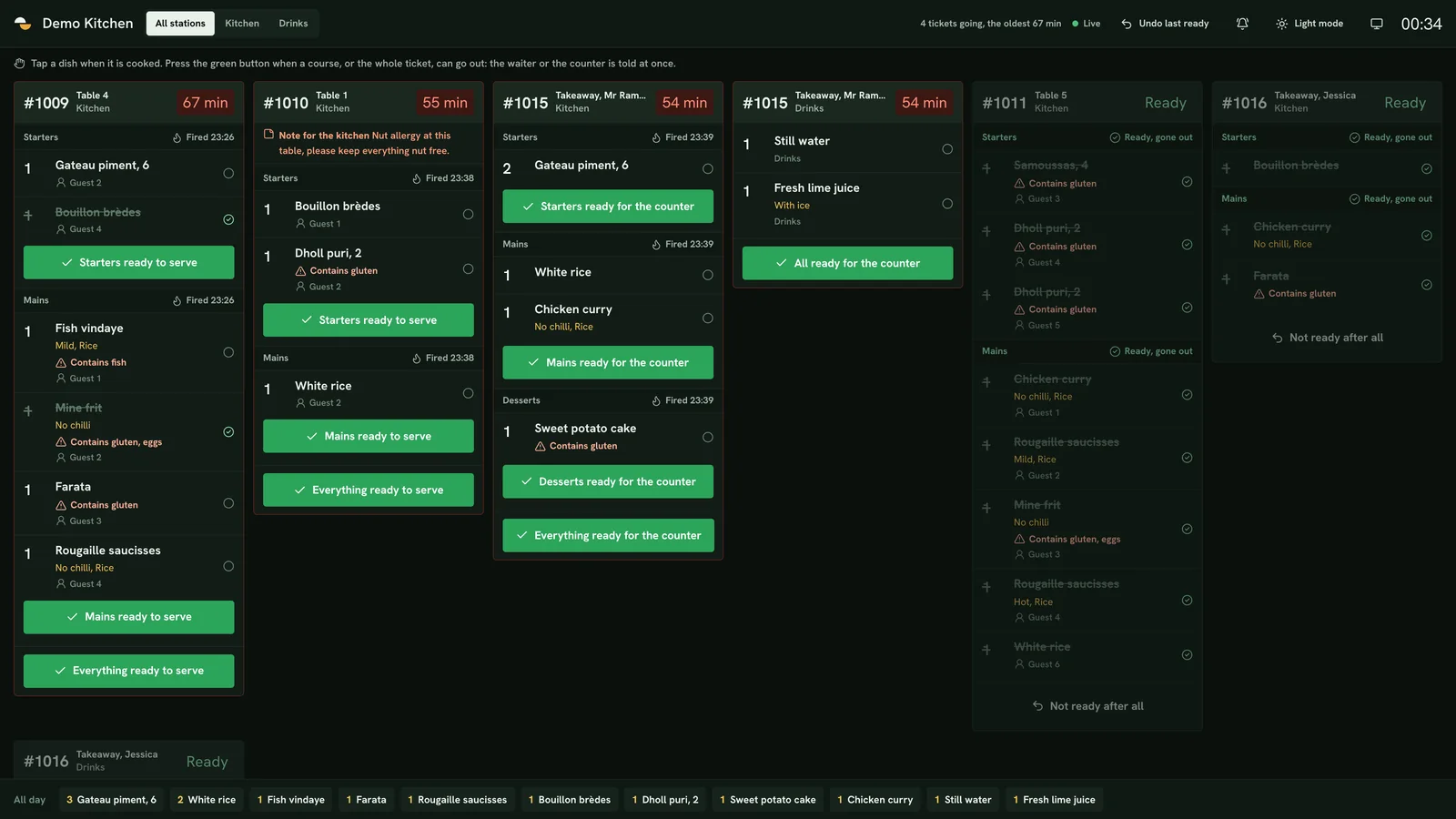
The detail that matters more than it sounds: marking a course ready should tell the waiter of that table, not every phone in the restaurant. A system that notifies everybody trains the staff to ignore it by the end of the first week.
One network: the waiter, the kitchen, the counter and the guest
The part that separates a management system from four pieces of software is that everyone is looking at the same order. A table shows the same status on the waiter’s phone, at the counter and on the manager’s floor plan: seated, in the kitchen, food ready, eating or bill asked. A guest scanning the QR code on that table lands on the bill the waiter already has open rather than starting a second one. Orders from the table, the code, the counter and your online page arrive on one kitchen display, and marking a course ready tells the waiter of that table rather than every phone in the building.
When that loop is broken, somebody re-types orders between systems. Every re-typed order is a chance to get a dish wrong, and it is also an order that never depletes the stock, which is why the figures and the shelves stop agreeing by the end of the month.
Stock and wastage, tracked to the dish
Ingredients, suppliers with their pack sizes and delivery days, recipes, stock counts, deliveries and waste all live in the same place. That gives the system two numbers worth more than any report: what a dish actually costs to make, and what the shelves should hold against what the count says they do. The gap between those two is where food cost goes, and no amount of sales reporting will find it.
The prep plan then works forward rather than back. Before a service it says how many of each dish to expect from the same weekday’s sales, which batches to make in house, and which ingredients will not last until the next delivery, with each supplier’s lead time against them. Over-prepping is the leak owners accept because it feels like service; prepping to the day is what stops it.
AI that reads your own figures
The back office and the app open on a short brief of the day so far: sales against the same day last week, the best sellers, what is running low, the voids worth a look and what tomorrow should bring. It updates as the service goes, so a manager walking in at six has the picture without opening a report.
- A seven-day forecast of orders and sales, built from the same weekday over the last four weeks and adjusted for the recent trend, with days you close left out. It is what a rota and a supplier order should be written against.
- Menu profit by dish, each one placed against the others in its own section as a star, a workhorse, a hidden gem or one to rethink, with the changes worth the most listed first and priced in rupees a month.
- AI menu import. Photograph the printed menu, or upload a PDF or a Word file, and it is read into dishes with prices, sections, allergens and options. A dish whose price cannot be read is left out rather than guessed.
- Jean, the assistant. Ask in your own words, for the dates you mean, about sales, stock, wastage, a dish’s cost, who worked when or what the hours cost. Jean reads the whole account, not one screen, and changes the menu when you tell it to.
The four parts people skip, and pay for later
- Stock against recipes. Without recipe costing there is no theoretical usage, and without theoretical usage you can see that the month was bad but never why. Food cost control covers the arithmetic.
- The audit trail. Voids after the kitchen has started, discounts, refunds and drawer openings without a sale, each with who did it and who approved it. This is the cheapest loss control a restaurant owns.
- Your own online orders. A delivery platform takes a share of every order and keeps the guest. Your own page takes the same order for the cost of the rider. Both have a place, and running both is usually right.
- What happens with no internet. Decide this in the showroom. In Ferculon each screen keeps showing its last view while the connection is down and staff can still clock in and out, then everything syncs when it returns.
Six questions that separate the systems
- Put three of my dishes in, with their options and prices. If that cannot be done inside a demonstration, it will not be faster after the contract.
- Show me the VAT on sales for a return period, not for a day, with credit notes in it.
- Take a wallet payment with its reference, then find it again in the day’s takings split by method.
- Void a sent dish as a waiter, then show me that attempt in the audit log.
- Show me last month’s best sellers and what each one made after its recipe cost.
- Export my orders and payments to a file I can open in a spreadsheet, during the demonstration.
We have run these six questions against every system sold on the island; the results are in choosing a restaurant POS in Mauritius. To see the screens above against your own menu, write to us.
Questions people ask
What is a restaurant management system?
Software that runs the whole restaurant rather than only the payment: the floor and the orders, the kitchen display, guests who book or order online, stock behind the dishes, the staff who are clocked in, and the takings, VAT and margin the owner reads afterwards. A point of sale is the part of it that takes the money.
What is the difference between a POS and a restaurant management system?
A point of sale records the sale. A management system also tells you what the dish cost to make, what the stock should be against what it is, who voided what and why, what the VAT on sales comes to for the return period, and what the next service will need. If a supplier calls a till a management system, ask to see the stock and the audit log.
Does a restaurant management system handle VAT in Mauritius?
It should. VAT is charged at 15 per cent and registration is compulsory once annual turnover of taxable supplies exceeds Rs 3 million, a threshold that came down from Rs 6 million on 1 October 2025. The system needs to hold your rate, whether prices include it, your BRN and VAT number on the receipt, and the VAT on sales totalled by return period.
Can one system handle dine-in, takeaway and delivery?
Yes, and it should. Orders from tables, table QR codes, the counter and your own online page can all arrive on the same kitchen display and the same back office. Where that is not true, somebody re-types orders from a second tablet, which is where mistakes and missing stock come from.
Does Ferculon send invoices to the MRA?
No. Ferculon does not transmit fiscal invoices to the MRA Electronic Billing System today. It records VAT at your own rate on every order, carries your BRN and VAT number on receipts, totals VAT on sales by return period, exports for your accountant and keeps a full audit log. If you are inside the mandate, tell us before anything else.
How much does a restaurant management system cost in Mauritius?
Suppliers price very differently and few publish a list. Ask each one for the full first-year figure including hardware, set-up and support rather than the monthly fee. Ferculon is quoted for each restaurant, because the number of tables, the stations in the kitchen and whether you deliver all change the work.