Food cost control is the work of knowing what each dish costs you to make, what it actually costs once the week is over, and why those two numbers are not the same. The gap between them is where a busy restaurant quietly loses its margin.
This guide covers the arithmetic, the five places cost leaves a kitchen, how to cost a recipe properly, and a weekly routine that fits around a service. It uses Ferculon for the examples, but the method works on paper.
The arithmetic, and the number that matters
Food cost percentage is the cost of the ingredients you used divided by the sales they produced, over the same period:
- Food cost percentage equals cost of ingredients used, divided by food sales, times one hundred.
- Cost of ingredients used equals opening stock, plus deliveries received, minus closing stock.
- Gross profit on a dish equals its selling price minus its recipe cost. The percentage is a ratio. The rupees are what you bank.
Ignore any article that tells you the right percentage for your restaurant. It depends on whether you grill imported steak or fry your own gateaux, on how much of your price is service and rent, and on what you can actually charge where you are. The number to beat is your own, last month.
The five places food cost leaves a kitchen
| Leak | How it shows up | First move |
|---|---|---|
| Portions drifting | One dish’s actual cost climbs while its recipe cost has not changed. | Weigh the portion for a shift. Put a scoop or a scale on the station. |
| Supplier prices moving | The recipe cost rises across a whole section of the menu at once. | Check cost against the last three deliveries, not against the price you first typed in. |
| Waste and spoilage | Stock counts fall faster than sales explain, often on fresh items. | Book waste as it happens, by item and reason, so the pattern is visible by Friday. |
| Over-prepping | The same items are thrown out at close most days. | Prep to what the same weekday actually sold, not to a feeling. |
| Voids, comps and staff meals | Sales are lower than the kitchen output, with no stock left over. | Require a reason and an approver on every void after the kitchen has started. |
That last row is the one restaurants look at last and should look at first. Ferculon’s loss watch lists voids after the kitchen, discounts, refunds, drawer openings without a sale and short tills, sets each person against the team average, and links every entry to the audit log so you can see who did it and who approved it.
Theoretical against actual: the comparison that finds the cause
Theoretical cost is what your sales say you should have used: every dish sold, multiplied by its recipe. Actual cost is what the shelves say you did use. Run both for the same week and subtract.
A small gap is normal: trim, spillage, a portion that ran heavy. A gap that holds week after week is a process, not an accident, and it has a cause you can name in the table above. A restaurant that only ever looks at the actual figure can see that the month was bad, but never why.
In Ferculon the theoretical side comes out of the system on its own, because ingredients are depleted by recipe as orders are sent to the kitchen. The actual side comes from counts, deliveries and waste entered on the shelves. The difference between them is the conversation to have with your head chef.
Costing a recipe so the number is true
Most recipe costs are wrong in the same four ways. Fixing them is an afternoon of work that pays for itself in a week.
- Cost the unit you cook in, not the unit you buy in. A sack of onions is bought by the ten kilos and used by the hundred grams. Convert once, properly, and store the conversion.
- Cost the yield, not the delivery. You pay for the whole fish and serve the fillet. The cost of the dish carries the trim.
- Include everything that leaves the store. Oil, the garnish, the sauce, the paper the takeaway goes in. Small items are where a tight-looking recipe loses two or three rupees a plate.
- Re-cost when prices move, from what you were actually charged on the last delivery, not from the price you typed in when you set the dish up.
- Cost the modifiers. Extra cheese and a double shot are free in most systems and are not free in your kitchen.
Reading the menu: four groups, four different moves
Once every dish has a true cost, put each one on two axes: how often it sells, and what it makes. Four groups fall out, and each one wants a different decision.
- Stars sell well and make well. Protect them: keep the portion exact, keep the ingredient in stock, and do not quietly raise the price.
- Workhorses sell well and make little. A small price rise or a few rupees off the recipe is worth more here than anywhere else, because it is multiplied by volume.
- Hidden gems make well and sell rarely. These are a menu and service problem, not a kitchen one: move them up the section, rename them, let staff recommend them.
- Ones to rethink sell rarely and make little. Rework the dish, or take it off and free the shelf space and the prep time.
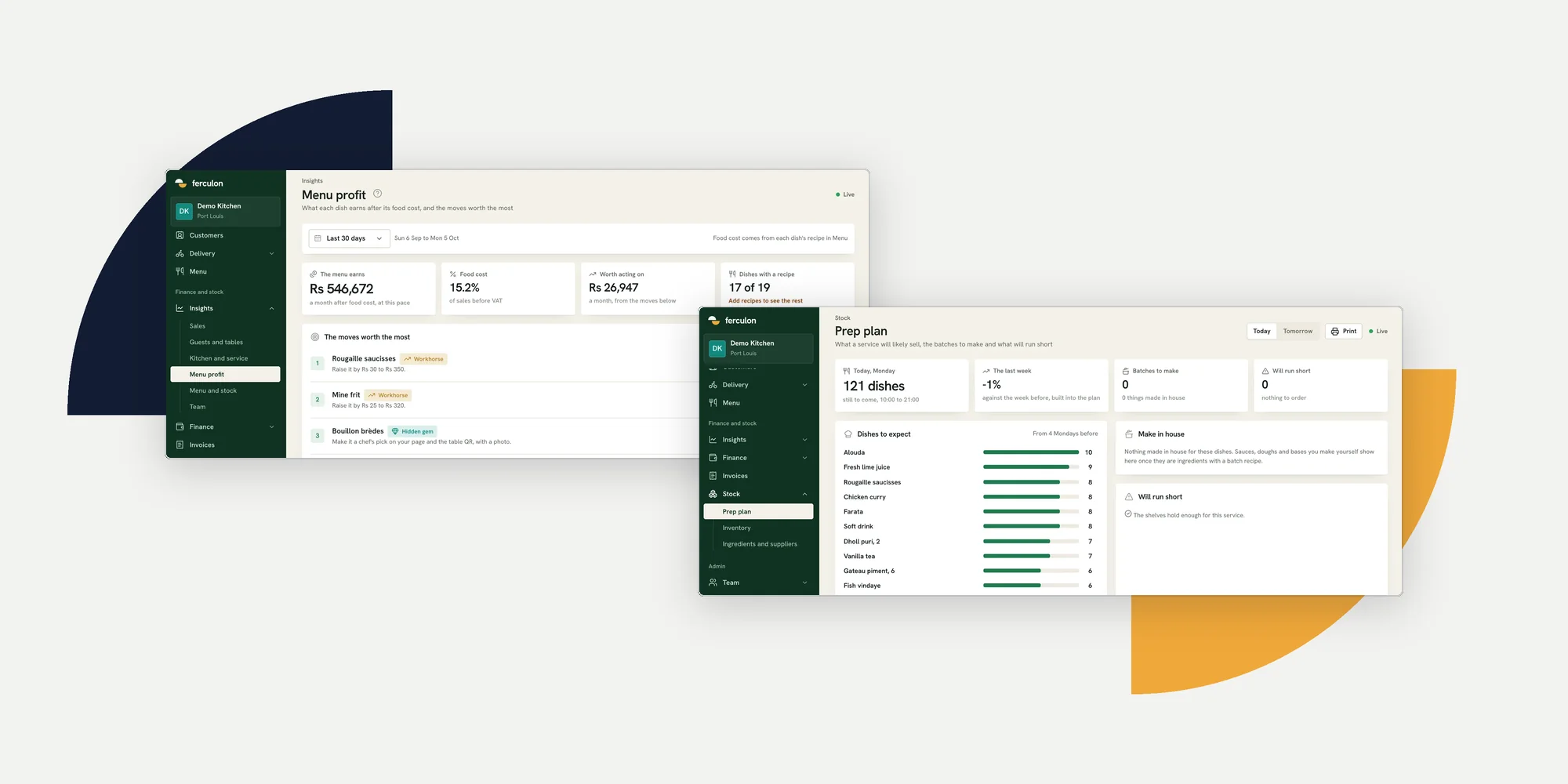
Ferculon groups your dishes this way on its own from recipe cost and sales, compares each dish with the others in its own menu section rather than with the whole menu, and ranks the changes it suggests by what each one is worth in a month.
One caution: this reads the past. A dish that sells rarely because it is at the bottom of a long section is not the same as a dish nobody wants. Change one thing at a time and look again in a month.
Prepping to the day, not to the week
Over-prepping is the leak owners accept because it feels like service. It is not: it is the cost of everything thrown out at close, every day, compounded.
The fix is to prep against what the same weekday actually sold. A Tuesday is not a Saturday, and the first Saturday of the month is not the last one. Ferculon’s prep plan estimates what the next service will sell from the same weekday’s history, says what to prep, and flags the items that will run out before the next supplier delivery.
Pair it with the kitchen marking dishes sold out as they go. A dish greyed out on the guest’s menu costs nothing. A dish ordered and then apologised for costs the table.
A weekly routine that survives a real service
Food cost control fails when it becomes a project. Make it four short habits instead.
- Daily, five minutes: book the waste as it happens, and glance at voids and discounts from the night before.
- Weekly, thirty minutes: count the twenty items that carry most of your cost, not the whole store. Compare theoretical against actual and write down one cause.
- Monthly, an hour: re-cost the recipes whose ingredient prices moved, then look at the four menu groups and make two changes. Only two.
- Each quarter: count everything, review supplier prices against what you were charged, and check that your par levels still match how you actually sell.
The habit matters more than the tooling. A restaurant that counts twenty items every Monday will beat one that counts everything twice a year, whatever either of them is running. To see how Ferculon handles the costing and the counts, write to us.
Questions people ask
What is a good food cost percentage for a restaurant?
There is no single right figure, and anyone quoting one without knowing your menu is guessing. It depends on what you cook, what you can charge and what your rent and labour take. Measure your own percentage for three months, then work on beating it. The trend is more useful than the number.
What is the difference between theoretical and actual food cost?
Theoretical cost is what your sales say you should have used: each dish sold, multiplied by its recipe. Actual cost is what your stock counts say you really used. Comparing them for the same week is the only reliable way to separate normal trim and spillage from portions drifting, waste or theft.
How often should we count stock?
Count the twenty or so items that carry most of your cost every week, and count everything each quarter. A short weekly count that actually happens is worth far more than a full count that gets postponed because it takes a whole evening.
Does a POS system calculate food cost on its own?
Only if it holds your recipes. A till that records sales can tell you what you sold, not what it cost. A system that depletes ingredients by recipe as orders are sent can produce the theoretical side by itself, and you provide the actual side with counts, deliveries and waste.
Should we raise prices or cut portions when costs rise?
Look at the dish first. If it sells well and makes little, a small price rise is usually better than a smaller plate, because guests notice the portion. If a supplier price caused it, re-cost the recipe and check whether another supplier or a different cut fixes it before you change anything a guest can see.