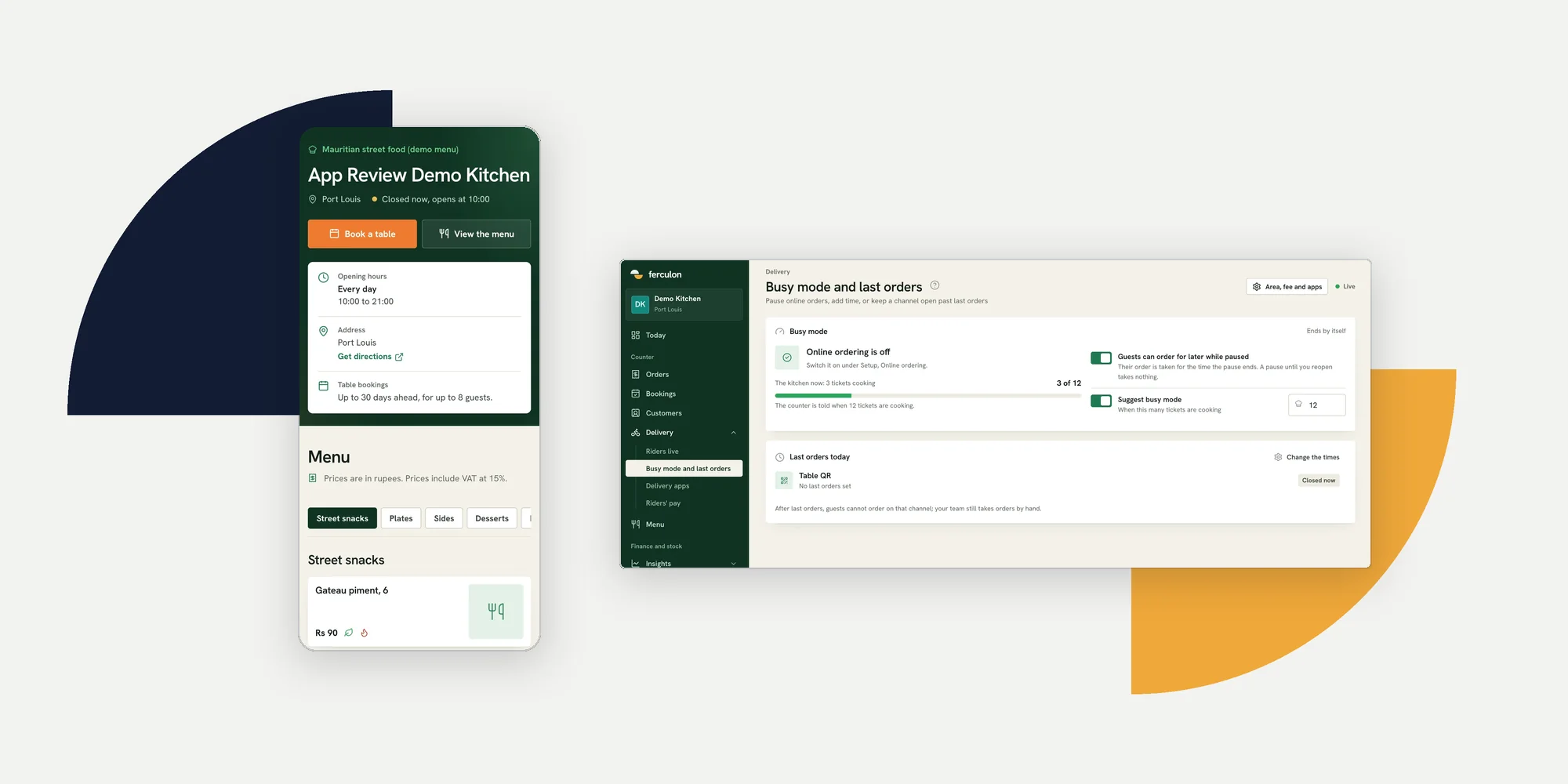
An online food ordering system is the page where a guest picks dishes, chooses pick-up or delivery and sends the order straight into your restaurant. Run on your own address it costs you no commission and the guest stays yours. Run through a delivery platform it costs a share of every order, and the guest belongs to the platform.
That is the whole decision. What follows is what each one actually gives you, what the page has to handle when the kitchen is full, and why most restaurants end up running both.
Your own page against a delivery platform
| Your own page | A delivery platform | |
|---|---|---|
| Commission | None | A share of every order, taken before you see it |
| The guest’s details | Yours: the number, the address, what they ordered last time | The platform’s |
| New guests | The people who already know you | Its marketplace is the reason to be there |
| Who delivers | Your own riders, your own area and fee | Its riders, its area, its timings |
| Where the order lands | The same counter screen and kitchen display as everything else | Usually a separate tablet, re-keyed by hand |
| What it costs to start | Set-up time | Almost none, which is the point |
The row that quietly costs the most is the second to last. An order re-typed from a platform tablet into the till is an order that can be typed wrong, that does not deplete your stock, and that will not appear in your figures where you expect it.
What the page has to handle on a Friday
A menu on a website is not an ordering system. These are the parts that decide whether the kitchen can live with it.
- Last orders for each channel. A delivery cut-off and a pick-up cut-off are rarely the same, and both are earlier than closing. Set them in minutes before you close, and let staff override.
- A way to pause. When the kitchen is twenty minutes behind, you need one switch that stops new online orders or adds time, not a sign on a door nobody online can see.
- Sold-out dishes greying out as they go. The kitchen marks the last portion gone and the online menu follows, before another guest orders it.
- A delivery area and a fee you control. Decide how far you will go and what it costs before someone orders from the other side of the island.
- Opening hours that are actually enforced. Orders arriving while you are closed are worse than no orders.
- One queue at the counter. Online orders, phone deliveries and walk-in takeaways belong on the same screen, in the same lanes.
Your own riders, and the cash they carry
Running your own deliveries is cheaper and harder. The two things that go wrong are always the same: nobody knows where the rider is, and nobody knows how much cash is in their pocket.
In Ferculon the counter accepts an order, the kitchen marks it ready and it is sent out with a rider. A live map shows every rider, their deliveries and the cash each one is holding until it is handed in, so the end of the night is a count rather than an argument. Delivery areas and fees are set in Setup, and distance is currently measured in a straight line from the restaurant, so set the area with that in mind if your roads wind.
Getting guests onto your own page
The page is the easy part. Being the thing people open is the work. In order of what actually moves orders:
- Put the link where people already look for you: your Google Business Profile, your Instagram bio, your WhatsApp away message.
- Print it on everything that leaves the kitchen, as a short address and a QR code on the bag, the receipt and the flyer in it.
- Tell the guests who are already in the room. Someone paying a bill in person is the cheapest person to convert to a direct order.
- Answer the phone with it. Repeat callers are happy to use a link once they know it exists.
- Give a reason to switch that costs you less than the commission does. Anything under the platform’s cut is still a win.
The honest case for running both
Most restaurants should. A platform is a marketplace: it reaches people who have never heard of you, and that reach is worth paying for. Your own page is where the people it finds should end up on their second order.
Treat them as two channels with two different jobs, and measure them separately. Compare what each one earns after commission, not what each one turns over. A hundred platform orders at a commission can be worth less than forty direct ones.
Two limits worth knowing. Ferculon’s own ordering page takes pick-up and delivery orders that are paid on collection or at the door, not online in advance. And orders placed inside a delivery app stay inside that app: no local platform publishes a way to pull them in, so those are still re-keyed. If online prepayment or app orders flowing straight into your figures is the thing you need most, say so when you talk to any supplier, including us.
To see the counter queue, the rider map and the busy switch on a real order, write to us.
Questions people ask
Is an online food ordering system worth it for a small restaurant?
Usually yes, because the saving is a share of every order rather than a fixed amount. The question is whether you have enough repeat guests to send to it. If most of your delivery orders already start with a phone call from someone who knows you, a direct page pays for itself quickly.
Can we take online orders without paying commission?
Yes, if the ordering page is on your own address and the orders arrive directly in your own system. You still pay for whatever delivery costs you, your riders or a courier, and for any payment processing. What you avoid is the platform’s share of the order value.
How do we stop online orders when the kitchen is overwhelmed?
With a busy switch that pauses online ordering or adds time to the quoted wait, set from the same screens the counter already uses. Each channel should also have its own last orders time, in minutes before closing, that staff can override when they choose to.
Do online orders reach the kitchen the same way as table orders?
They should. In Ferculon, orders from the table, the QR code, the counter and the online page all appear on the same kitchen display, sorted by course and station. If a system puts online orders somewhere else, someone has to re-type them, which is where mistakes and missing stock come from.
Should we leave the delivery apps once we have our own page?
Rarely straight away. The apps bring people who do not know you, which your own page cannot do. Run both, measure what each earns after commission rather than what each turns over, and move repeat guests to your own page over time.