MRA e-invoicing for restaurants means sending each invoice and credit note to the Mauritius Revenue Authority as it is issued, and printing the reference the MRA sends back on the guest’s receipt. It is being phased in by turnover, so the first question is not how to do it. It is whether it reaches your restaurant yet.
This guide sets out the thresholds as they stand, what a registered billing system has to do, and the questions to put to whoever sells you a point of sale. It is not tax advice: confirm your own position with the MRA or your accountant before you act on it.
Who it applies to, and from when
The rules sit under the VAT Act, so they reach VAT-registered taxpayers, and the MRA has brought them in group by group, largest first.
| From | Who it reached |
|---|---|
| 15 May 2024 | Limited companies with turnover above MUR 100 million |
| 1 August 2025 | Micro, small and medium traders with turnover above MUR 100 million |
| 30 June 2026 | Micro, small and medium traders with turnover above MUR 80 million |
| 1 September 2026 | Micro, small and medium traders with turnover above MUR 40 million |
Most independent restaurants in Mauritius sit below MUR 40 million a year, so the mandate has not reached them. Hotel groups, restaurant groups and large caterers are a different matter, and the thresholds have only moved in one direction so far.
How fiscalisation actually works
The mechanism is the same whether the seller is a restaurant or a hardware shop. Six steps, all of them inside the software.
- Your billing system is registered. The software has to be an Electronic Billing System registered with the MRA, and the business itself is onboarded and given an EBS identifier.
- The bill is raised as usual. Your staff close the table or the counter order the way they always have.
- The invoice is sent to the MRA. The system transmits it as structured JSON over the MRA’s interface, in real time, before the document is given to the guest.
- The MRA validates and answers. It returns an invoice reference number and a QR code for that document.
- The receipt carries both. The reference and the QR code are printed or displayed on the guest’s copy, and the guest can check it against the MRA.
- The record is kept. The fiscalised documents are archived, in sequence, for an inspection later.
Credit notes and debit notes go the same way. A refund is not a quiet correction in the till: it is its own document, with its own reference.
What a registered billing system has to do
Beyond sending the document, the MRA’s specification asks for things an ordinary till does not have. These are the parts restaurants are usually missing.
- A non-resettable invoice number. A sequence that counts up and cannot be wound back, kept apart from your order numbers.
- A digital signature on each document, so an invoice cannot be altered after the MRA has seen it.
- The seller’s details in full: business registration number, VAT number, the invoice number and the VAT amount on the document itself.
- A buyer who is a company recorded with their own name and numbers, so they can claim the input VAT on the staff lunch they just paid for.
- Credit and debit notes tied to the invoice they correct, with the reason on them.
- A way to carry on when the link to the MRA is down, and to send what piled up once it is back.
Failing to issue fiscal invoices when you are required to carries a penalty for each month, or part of a month, that it continues, capped at MUR 200,000. The cap is worth noting mainly because it tells you how seriously the measure is meant.
What changes in the restaurant itself
Less than owners expect, and in different places than they expect.
- The receipt gets longer, carrying the reference and a QR code the guest can scan.
- Refunds get slower and more formal. Cancelling a paid bill becomes a credit note with a reason, not a line deleted by a manager.
- The till cannot be “fixed” after the fact. Once a document is fiscalised, the correction is another document.
- A dropped connection becomes an operational question, not just an annoyance. Ask your supplier what the counter does in those minutes.
- Your figures and the MRA’s figures should match exactly, which makes a clean VAT setting and a clean audit trail worth more than they were.
What to ask whoever sells you a point of sale
- Are you registered with the MRA as an EBS solution provider, and under which name. Ask to see it on the MRA’s own list, not on a brochure.
- Is fiscalisation included, or is it a separate module with its own price.
- Who onboards my business with the MRA, and how long that takes.
- Show me a fiscalised receipt printed from your system, with the reference and the QR code on it.
- Show me a credit note raised against an invoice that has already been fiscalised.
- What happens during an outage, and how the queued documents are sent afterwards.
- If I am below the threshold today, what exactly do I have to do on the day it reaches me.
If it has not reached you yet
The useful work is the record keeping, and it pays for itself whether or not the mandate arrives. Four things to get right now:
- Put your BRN and VAT number on the receipt and keep the VAT rate and the inclusive or added setting correct, so what the guest holds is a proper VAT receipt.
- Total your VAT on sales by return period, rather than adding up days by hand at the end of the quarter.
- Record refunds as their own entries, with a reason and an approver, so you are already working the way a credit note works.
- Keep every void, discount and drawer opening in an audit log. It is what an inspection asks for, and it is the same record that tells you where money is leaking.
What Ferculon does today
Plainly: Ferculon does not transmit fiscal invoices to the MRA’s Electronic Billing System. If your restaurant is inside the mandate today, that is the first thing to raise with us.
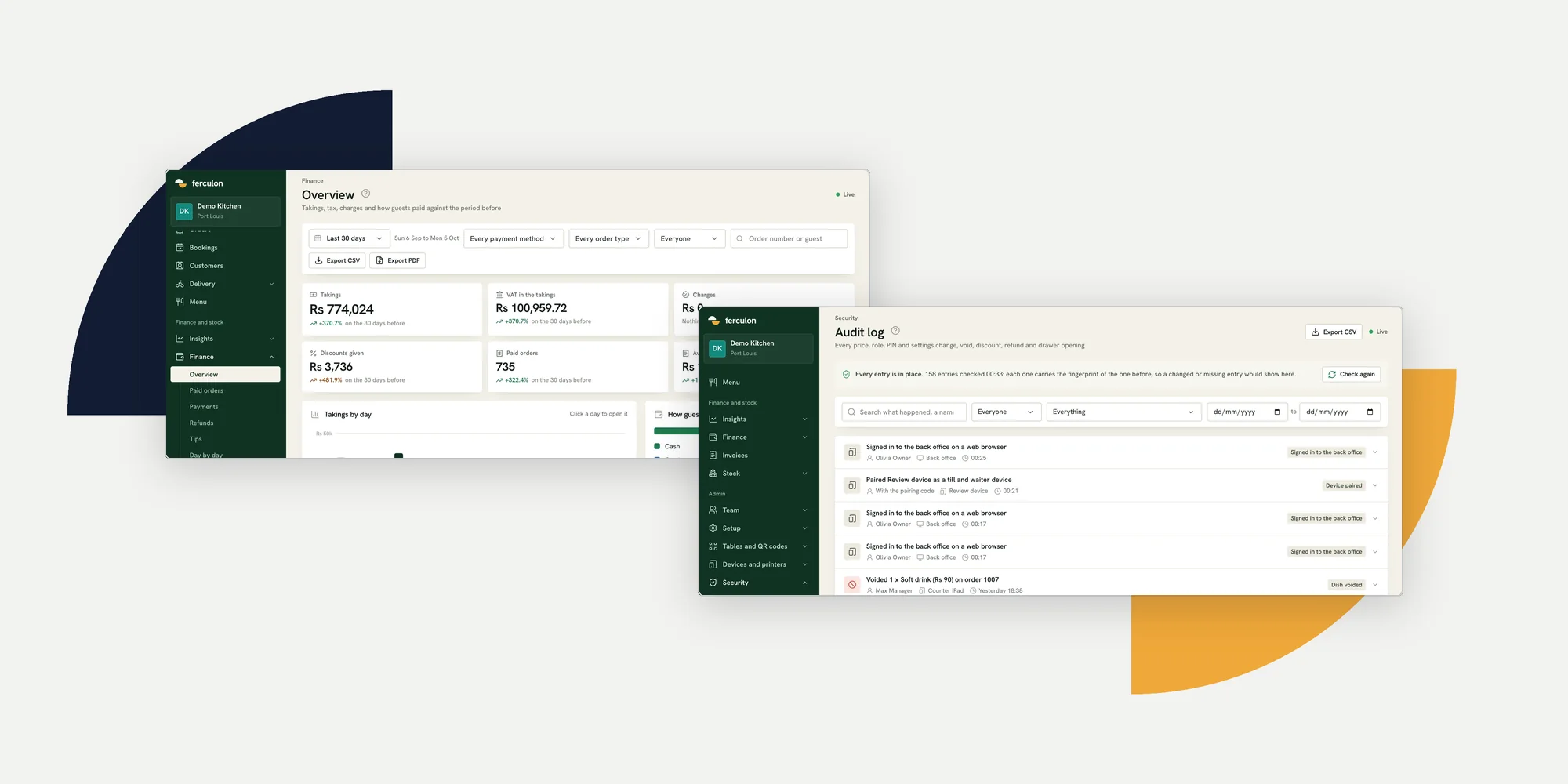
What it does do is the record keeping above. The tax engine is set to your own rate and to whether prices include VAT, and each order keeps the rules it was priced under. The receipt carries your business registration and VAT numbers. The back office totals the VAT on sales for each return period and exports orders and payments for your accountant. The audit log holds every price, role and settings change, every void, discount and refund, and who approved each one.
If you want to talk through where your restaurant sits against the thresholds, write to us.
Questions people ask
Does MRA e-invoicing apply to my restaurant?
It applies if you are VAT registered and your turnover is above the threshold in force for your category. The phases announced so far reached limited companies above MUR 100 million in May 2024 and micro, small and medium traders above MUR 40 million from 1 September 2026. Most independent restaurants sit below that, but the Director-General can also require a taxpayer to join regardless of turnover, so confirm your own position with the MRA.
What is an EBS?
An Electronic Billing System is the software that raises your invoices and sends them to the MRA for fiscalisation. It has to be registered with the MRA, and your business is then onboarded and given its own identifier. A point of sale is only an EBS if its supplier has gone through that registration.
What has to be printed on a fiscalised receipt?
The invoice reference number the MRA returns and a QR code the guest can scan to verify the document, alongside the usual seller details: the business registration number, the VAT number, the invoice number and the VAT amount.
What is the penalty for not using the system?
Failing to issue fiscal invoices when required carries a penalty for each month or part of a month that it continues, capped at MUR 200,000. Check the current figures with the MRA, since penalties are set in the legislation and can change.
Does Ferculon do MRA e-invoicing?
No. Ferculon does not transmit fiscal invoices to the MRA Electronic Billing System today. It records VAT on every order at your own rate, carries your BRN and VAT number on receipts, totals VAT on sales by return period, exports for your accountant and keeps a full audit log. If you are inside the mandate, tell us before anything else.
Should we wait for the mandate before changing our POS?
Waiting rarely helps. The records a fiscal system needs, correct VAT settings, proper receipts, refunds as their own documents and a complete audit trail, are the same records that make a restaurant easier to run now. Get those right, and whichever system you fiscalise through later has clean data to start from.