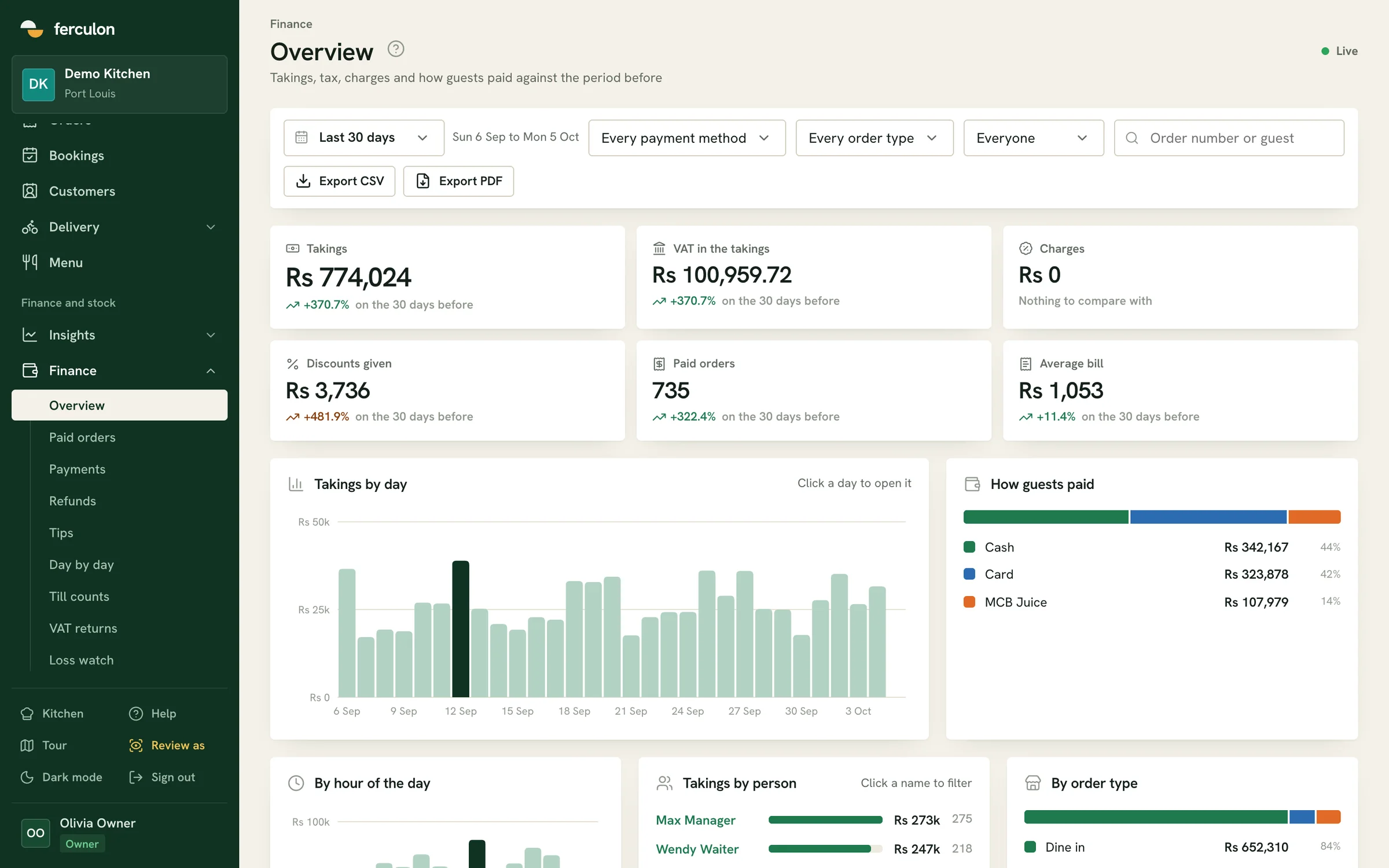
A restaurant closing checklist assigns the last service tasks to named people and records when the restaurant is ready for its next opening. Include open bills, the cash count, food storage, cleaning, stock, staff hours and security. For the manager, the useful final check is whether the physical restaurant agrees with the records you are leaving behind.
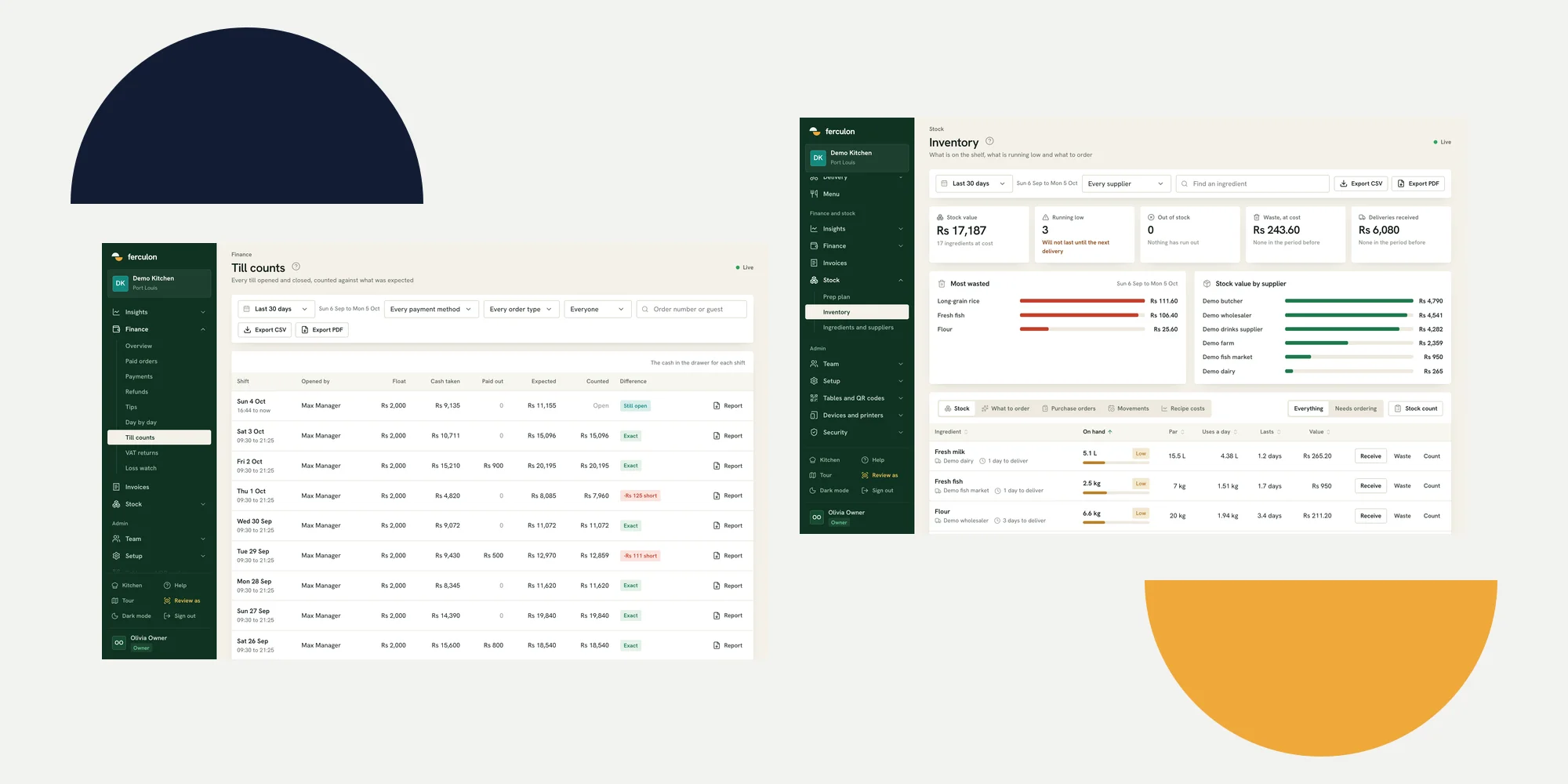
Start with the cash drawer. In the Ferculon back office, Till counts puts the expected amount, the amount counted and the difference beside each shift. The demo restaurant shows a MUR 125 shortage on one close. That is a specific question to investigate before the team leaves, with a report and cash movements to consult.
Assign the restaurant closing checklist before service ends
Put the service date, closing manager and next opening lead at the top of your sheet. Assign each duty before the last rush so staff know what they own. A restaurant that closes after midnight should also write the calendar date beside completion times. Keep the service date consistent with the reports you use.
| Closing responsibility | Responsible person | Record to check |
|---|---|---|
| Resolve bills and payment exceptions | Floor lead | Open bills reviewed; each exception explained |
| Count and reconcile each drawer | Authorised cash handler | Expected, counted, difference and shift report |
| Store food, clean and check equipment | Kitchen and station leads | Approved cleaning and food-safety records |
| Record waste and priority stock counts | Kitchen lead | Item, quantity, reason and low-stock follow-up |
| Reset dining and guest areas | Named floor closer | Walk-through and supplies ready for opening |
| Review hours and unfinished work | Closing manager | On-clock review and handoff to opening lead |
| Secure the premises | Designated last person | Final check under the restaurant security procedure |
Give each station its own completion record when different people finish different work. One signature for the whole kitchen can hide an unfinished station. Use a completion time and a short note where something remains unresolved. Keep your approved cleaning, storage, equipment and security instructions beside the checklist so the person signing knows what finished means.
Resolve bills before counting the drawer
Ask the floor lead to review outstanding tables, takeaway orders and delivery collections before the cash count begins. Confirm which payments have actually arrived and which still need attention. A guest payment, a refund and a rider handing over collected cash are different events, and each needs the right record.
Work through partial payments and split bills while the people who handled them are still available. The restaurant billing workflow explains how orders and payments fit together. Leave a specific explanation for any authorised outstanding bill, including who will follow it up.
Closing a till in Ferculon records how many orders are still open at that moment. Review those orders separately before signing your checklist. A completed drawer count does not establish that every customer has paid. Where a connection has been interrupted, confirm that pending records have synced before treating the final report as complete.
Check the expected cash against the physical count
Choose the correct till and shift, then count the cash physically present. Keep card and mobile-wallet receipts separate from cash in the drawer. Your expected cash also reflects recorded movements such as money put in, paid out or removed, along with cash refunds and cash tips. Looking only at sales can leave you comparing different totals.
- Review the shift and the recorded cash movements before counting. Keep supporting receipts with payouts and other adjustments.
- Count the drawer using your cash-handling procedure and enter the amount actually present. Check denominations again if the figures differ.
- Compare counted cash with expected cash. Investigate the payment, refund or movement behind a difference while the staff involved are available.
- Save the shift report and record the explanation or the person responsible for follow-up. Complete the deposit and next-float procedure separately.
The approved Demo Kitchen screen below contains an October 1 shift with MUR 8,085 expected and MUR 7,960 counted. The calculation is 7,960 minus 8,085, giving minus 125: the drawer is MUR 125 short. These are historical demonstration figures in Mauritian rupees; apply the same comparison in your restaurant’s currency.

Use Cash movements to follow recorded entries and their reasons, then open the shift Report for the retained record. A difference is a prompt to investigate. It does not, by itself, establish theft or identify who caused an error. Keep the actual count intact while you document what you found.
Record waste and count the ingredients that matter
Ask each station to record discarded ingredients or prepared dishes while the quantity and reason are still clear. Separate known waste from a physical stock count. Recording spoiled food explains a loss; counting the shelf establishes what remains. Doing both carefully gives the opening team a usable starting point.
Ferculon’s stock workspace brings deliveries, counts and waste together. Its waste reasons include made too much, dropped or spilled, and spoiled or past its date. Choose the reason that matches what happened, then check any ingredient that could prevent tomorrow’s opening menu from being served.
In the approved inventory demo, three ingredients are running low. Fresh milk shows 5.1 litres on hand against a 15.5-litre par, with a supplier lead time of one day. That gives the closing manager something concrete to discuss with the opening lead: the available quantity and the delivery needed. It is a demo stock position, not a recommended par for every restaurant.
The same screen displays waste at cost for its selected date range. Check that range before using the figure in a nightly note. A last-30-days total belongs in a period review, whereas tonight’s close needs tonight’s entries. Use the inventory management guide when setting up ingredient units, deliveries and the count routine.
Reset the floor and kitchen for opening
Run the physical close alongside the records. Kitchen leads check food storage and cleaning against the restaurant’s approved procedures, complete the required logs and escalate any problem immediately. Staff trained on each appliance follow its shutdown or overnight-running instructions. Keep refrigeration and other equipment in the state those instructions require.
On the floor, clear and reset tables, replenish the service station, check guest facilities and put ordering devices on charge. Confirm the opening team has receipt paper and the supplies needed to start service. Give the bar its own owner when glassware, stock and equipment need a separate close.
The manager should walk the areas that have been signed off. A tick shows someone recorded completion; a walk-through establishes whether the room is ready. Fix issues that need attention tonight and identify supplies or repairs that the next shift must handle. Food-safety, equipment and security problems follow your immediate escalation procedure.
Review hours and hand over unfinished work
Check the team time clock and roster before staff leave. Confirm who is still working, who has finished and who opens next. Resolve time-record questions with the employee while the details are fresh, following your approval process. Closing duties belong within the work you record.
Keep the handoff short enough for the opening lead to read before service. Write the item, the current position, the next action, the responsible person and the deadline. Use your existing handover sheet or communication channel, and confirm the recipient has seen any item that could delay opening.
| Field | What to write |
|---|---|
| Issue and supporting record | The exact bill, till report, ingredient or equipment involved |
| Position at close | What was checked, the quantity or difference, and what remains |
| Next action and person | One action assigned to the person who can complete it |
| Due time and acknowledgement | When it must be resolved and when the opening lead received it |
Protect cash reports and staff information through your usual access controls. The team needs the action relevant to their role; the authorised manager retains the detailed financial records. Finish the premises security check only after confirming everyone has left through the correct route.
Test the close before choosing a POS
During a trial, follow one complete service through the closing routine. Find an open bill, inspect a cash movement, compare a physical count with the expected drawer amount and retrieve the shift report. Then locate an ingredient, check its unit and record the stock work your team normally performs.
Ask the manager who will use the system to perform those steps. They should be able to explain where a figure came from and what they would do when it differs from the physical count. If you need help mapping your existing closing procedure to the screens, contact Ferculon with your restaurant’s workflow.
Questions people ask
What should a restaurant closing checklist include?
Include outstanding bills, cash reconciliation, food storage, cleaning, equipment checks, stock and waste, staff hours, a handoff and security. Assign each duty to a named person and define the record or physical condition the manager checks.
How do you calculate a cash drawer shortage?
Subtract expected cash from the cash physically counted. In the Ferculon demo, MUR 7,960 counted minus MUR 8,085 expected equals minus MUR 125, a shortage that needs investigation.
Does closing the till mean every bill is paid?
No. Ferculon records the number of open orders when a till closes, so review outstanding bills separately. Record the reason and responsible person for any authorised exception.
Should stock counts and waste be recorded separately?
Yes. A stock count establishes what remains, while a waste entry records what was discarded and why. Review the date range when reading waste totals so a period total is not mistaken for one night’s loss.
Who checks the completed closing checklist?
The designated closing manager reviews the records and walks the relevant areas before final sign-off. The opening lead receives any unfinished work with a named responsible person and a due time.