Working out how to open a restaurant in Mauritius is mostly a question of order. The licence depends on the premises, the premises depend on the fit-out, and the fit-out depends on money you cannot spend until the company exists. Doing these in the wrong sequence is what turns three months into nine.
What follows is the order that works, with the authorities named and the parts that catch people marked. Rules and fees change, so treat it as a map and confirm each step with the authority itself.
The paperwork, and who issues what
| What | Who issues it | When to start it |
|---|---|---|
| Business registration | Corporate and Business Registration Department | First. Almost nothing else can be applied for without the business registration number. |
| Tourist Enterprise Licence | Tourism Authority | Once you have premises and a business registration. Read the Authority’s restaurant guidelines before you fit out. |
| Trade fee or local licence | The Municipal Council or District Council the premises sit in | Alongside the licence application. Which authority applies depends on where you are and the kind of establishment. |
| Health clearance for food handlers | Ministry of Health and Wellness | Before you hire the kitchen, not after. Everyone handling food needs it. |
| Building and land use permission | The local authority | Before any work on the premises, including a change of use. |
| VAT registration | Mauritius Revenue Authority | As soon as your expected turnover crosses the threshold. See below. |
Many of these can be started through the Economic Development Board’s business support portal, which lists what each licence needs and takes some applications online.
The order to do it in
- Decide the kind of restaurant and the catchment before the site. A set lunch counter in a business district and a beachfront dinner restaurant are different businesses with different licences, hours and staff.
- Register the business and open the bank account. Everything downstream asks for the registration number.
- Find the premises and check the use with the local authority before you sign a lease. A lease on a site that cannot be used as a restaurant is the most expensive mistake on this list.
- Read the Tourism Authority’s restaurant guidelines and design the kitchen and the public areas to them, rather than designing first and discovering them at inspection.
- Apply for the licences, with the plans, the lease and the registration in hand.
- Fit out and buy the equipment, leaving the cash for the first three months of trading untouched.
- Hire and get the food handler clearances, then train on the real menu on the real system.
- Run a soft opening for friends and family, at full service pace, and fix what breaks.
Tax, VAT and the threshold that moved
VAT in Mauritius is 15 per cent. Registration becomes compulsory once your annual turnover of taxable supplies exceeds, or is likely to exceed, Rs 3 million. That threshold was lowered from Rs 6 million with effect from 1 October 2025, which pulled a large number of small restaurants into VAT for the first time.
Three consequences worth planning for:
- Your menu prices are a decision, not a default. You choose whether the price a guest reads includes VAT or has it added at the till. Set it once, in the system, and let every order carry it.
- Your receipt has to be a proper one. Your business registration number and VAT number belong on it, with the VAT shown.
- Returns are filed on a cycle set by your turnover. The MRA tells you whether you file monthly or quarterly, so build the figures that way from the first week rather than reconstructing them later.
Separately, the MRA is phasing in fiscal e-invoicing by turnover. It does not reach a new restaurant, but it is worth knowing where the line is before you choose a billing system: MRA e-invoicing for restaurants covers the thresholds.
The costs nobody budgets for
Fit-out and equipment get a spreadsheet. These rarely do, and they are what empty the account in month two.
- The months between the lease and the opening, when rent is going out and nothing is coming in.
- Training at full pay before there are guests, which is the difference between a soft opening that fixes problems and one that creates them.
- The opening stock, bought in full before a single bill is paid by anyone.
- Deposits: the lease, the utilities, the gas, sometimes the suppliers until you have a history with them.
- The quiet first weeks. Budget on a slow first month, not on the night your friends come.
- Power interruptions. Decide early what the kitchen and the till do when the electricity goes, because it will.
The systems to settle before the first guest
The point of doing this before you open is that every one of these is twice as hard to put in during service.
- The menu, costed. Every dish with its recipe, so you know its margin on day one instead of discovering it in month three.
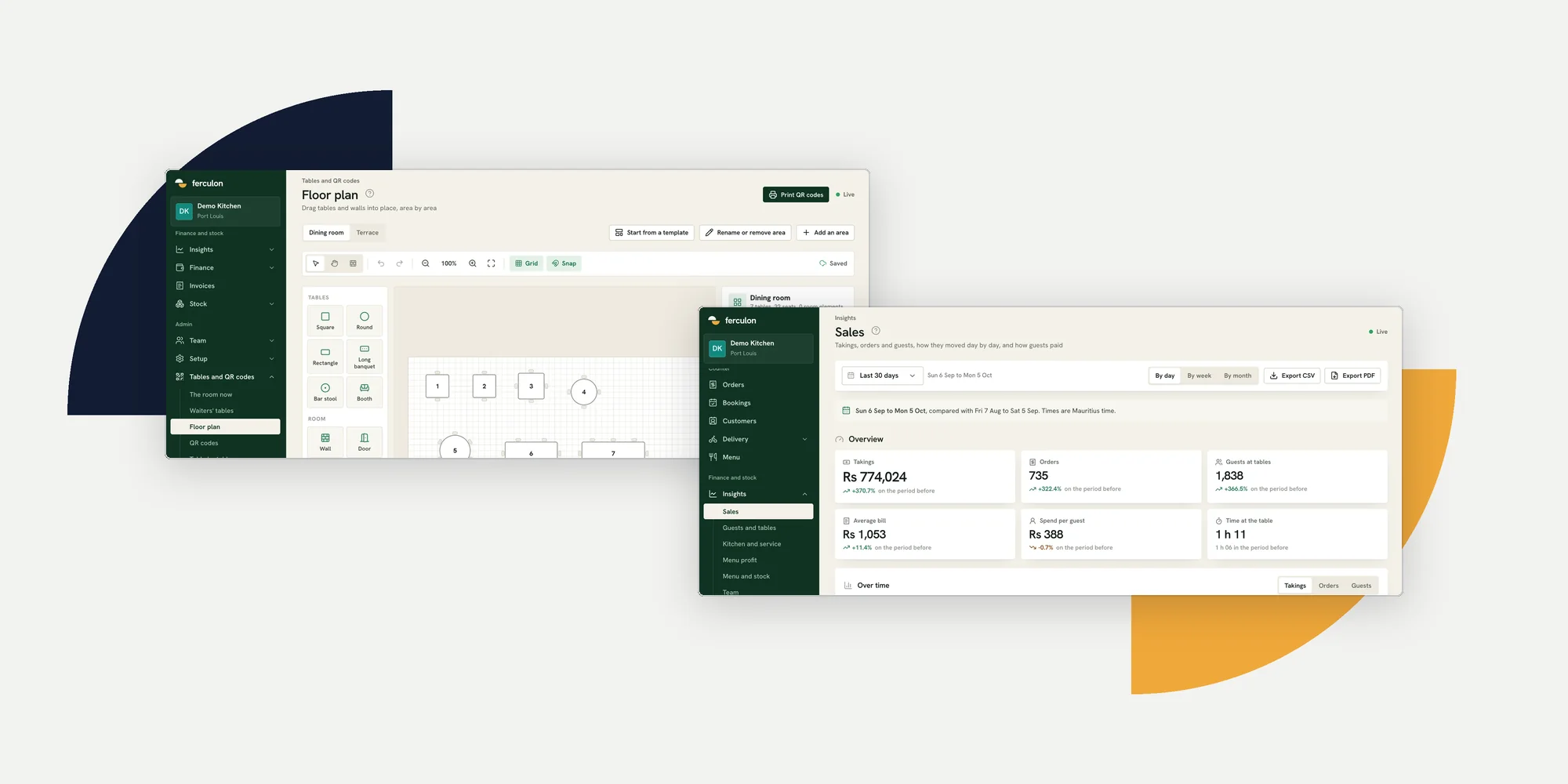
- The room, drawn. Tables, areas and numbers your staff and guests agree on. It is also what table QR codes and bookings attach to.
- Tax and payment methods. The VAT rate, whether prices include it, and each payment method you will take, with the reference staff must record for a wallet transfer.
- Roles and PINs. Who can void, who can discount, who can refund, and who approves each. Decide it before anyone is under pressure to ask.
- The kitchen’s screen or printer, with the stations split the way the kitchen actually works.
- Your own ordering page, if you will do pick-up or delivery, with your delivery area and your last orders time.
Ferculon walks a new restaurant through exactly these in its set-up: the basics, the menu and the room, money, then the team and devices. Accounts are opened by invitation, so write to us before you open rather than in the week you do.
What to watch in the first month
Opening is a project. Running is a habit. Four numbers tell you almost everything in the first weeks, and all four come out of a system that was set up properly.
- Covers and average bill, by service. Lunch and dinner are separate businesses and should be read separately.
- Food cost against your recipes. The gap between what you should have used and what you did is the first thing to go wrong in a new kitchen.
- Time at the table and time in the kitchen. Slow tickets at seven o’clock decide whether you turn a table at nine.
- Voids, discounts and short tills. Not because you suspect anyone, but because a new team invents habits in the first month and those are the ones that stay.
Fix one thing a week. A restaurant that changes one thing every Monday for a year is unrecognisable by the next one.
Questions people ask
What licence does a restaurant need in Mauritius?
A restaurant normally needs a business registration, a Tourist Enterprise Licence from the Tourism Authority, and a trade fee or licence from the Municipal or District Council where the premises are. Food handlers need health clearance, and any building work or change of use needs the local authority’s permission. Which bodies apply depends on the size and kind of establishment, so check with the Tourism Authority and your local council early.
How long is a Tourist Enterprise Licence valid?
Twelve months from the date of issue, or a shorter period if the Tourism Authority sets one. Apply to renew within the three months before it expires. A renewal made within thirty days after expiry may carry a surcharge of 50 per cent on top of the renewal fee, and the licence lapses if it is not renewed within thirty days.
When does a restaurant have to register for VAT in Mauritius?
Registration is compulsory once annual turnover of taxable supplies exceeds, or is likely to exceed, Rs 3 million. That threshold came down from Rs 6 million with effect from 1 October 2025. VAT is charged at 15 per cent, and the MRA sets whether you file monthly or quarterly based on your turnover.
What should we set up before opening day?
The costed menu, the room drawn with its table numbers, the VAT setting and payment methods, who is allowed to void, discount and refund, the kitchen’s screen or printer split by station, and your own ordering page if you will take pick-up or delivery. All of these are far harder to put in once service has started.
How much money should we keep back after the fit-out?
Enough to cover rent, wages and stock through a slow first month and a half, before counting any revenue. The costs that catch new restaurants are the ones between signing the lease and the first paid bill: rent during the fit-out, training at full pay, opening stock and deposits.
Does MRA e-invoicing apply to a new restaurant?
Not at the thresholds announced so far, which start at turnover well above what a new restaurant takes. It is still worth knowing where the line sits before you choose a billing system, because the records a fiscal system needs are the ones you want from the first week anyway.